
All Articles
AI: A Double-Edged Sword for the Future!


Does AI replace our jobs?
Can AI truly understand human
emotions and context?
Is AI threatened ?
Artificial Intelligence (AI) is a branch of computer science aimed at developing intelligent machines that can perform functions similar to those of the human mind. These include acquiring knowledge, thinking, solving problems, comprehension of language, and the capability of perceiving the physical outlook of things. AI comprises of several
branches including machine learning, NLP, computer vision, and robotics. Artificial intelligence consists of machine learning, which can improve performance by feeding data into a system without being programmed to do so. Natural language comprehension is the capability of a computer to interpret and understand the words and language used by humans, while computer vision is the ability of a computer to decipher pictures and graphics.
Based on the above image, one can determine the AI hierarchy and specific uses of the technology. At the highest level there is AI, which is comprised of Machine Learning (ML), which aims at creating algorithms that would enable computers to learn from data. Within ML is deep learning, which utilizes artificial neural networks to learn intricate representations. At the center of it is generative AI, which deals with the generation of content. Applications of generative AI are therefore multiple and include text generation (summarization, translation, content editing, etc.), image and video generation (creation and editing of images and videos, game assets, for instance), and lastly, task generation fine-tuning, including the construction of virtual assistants and automated tools. This multi-layered approach is also illustrative of how individual AI technologies form a more comprehensive whole, which creates innovative and practical formations in diverse disciplines.
In this case, AI holds a lot of worth to society in different fields. AI technologies can interpret medical images more effectively than physicians, diagnose diseases in their
early stages and contribute to the creation of individualized treatments for patients. In education, AI offers individualized instruction, follows the pace of learning of the students, and handles administrative work operations, freeing up the time of educators. AI solutions can pinpoint the student’s learning style and prevent them from reducing their learning results through tailored lessons.
’Does AI replace our jobs?” This question captures the essence of how the future of the workforce is being disrupted by the rise of artificial intelligence. On one end, AI
Particularly the automation of routine processes drastically improves operations throughout a variety of business sectors. For example, in manufacturing, automation helps to eliminate the need for manpower to do monotonous tasks, while in finance, the machine can analyze big data beyond the capability of human analysts, therefore eliminating existing jobs. The above efficiencies normally result in the elimination of specific jobs, especially those that entail manual or clerical work, provoking issues of job loss and downplaying specific skills within organizational settings. On the other hand, AI is a significant job generator, generating new occupations that require complex
skills. Due to the current technological advancement and innovation in AI, there are new careers in the current society, such as machine learning engineers, data scientists, and AI ethics compliance officers, that were nonexistent in the past several decades. There is also the use of AI in the transportation industry, where the industry gains from the design of self-driving cars. Such vehicles apply artificial intelligence algorithms to drive, dodge another automobile, and decide on ‘high alert’ without the need
for human intervention, thus minimizing the occurrence of calamities and traffic signals’ inefficiency. AI is used in fraud detection, algorithmic trading, credit scoring, and customer interaction in the context of finance. AI systems can review large amounts of transaction data in real-time and identify signs of fraud, which would work for fraud
detection and provide better credit ratings. Further, AI assists in environmental protection through the tracking of deforestation activities. monitoring of wildlife, early warning of disasters, and resource utilization. AI also has the potential to assist in determining at which areas environmental deterioration is likely to take place and thus where conservation efforts should be directed by using processed data such as satellite imagery.
Like any other technology, there are challenges and risks associated with the use of AI. One of the main issues is the threat to employment where automation intervenes and displaces human labor in several sectors, causing shifts in the economy that may require learners to be retrenched and trained in new jobs. It can enhance productivity and efficacy, yet it poses major risks, foremost of which is misemployment, especially in industries such as manufacturing, customer service, and transportation. Another critical issue is bias and discrimination that determine to some extent the AI algorithms. Unfortunately, if the training data has biased results, the AI models will strengthen or replicate these biases and may lead to incorrect decisions such as those about employment, criminality, and credit scoring. To remove bias from AI methods, the data used and the process of making and designing algorithms need to be fair and transparent.
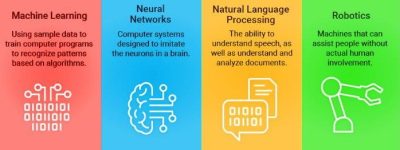
This image captures four major fields of artificial intelligence. Machine learning is a way of utilizing data to train computers to identify patterns and make decisions. Neural network models imitate the brain cells, the neurons, when dealing with intricate data. Natural language processing involves feeding human language into computers so that they can interpret it. Robotics entails building machines that can perform tasks in an organized manner by themselves. All these areas collectively contribute to the improvement of AI tech advancement and the field’s usage. Privacy issues are also significant since AI systems need massive volumes of personal data to provide proper solutions. This creates concerns about data privacy and protection or the misuse or access of the data by unauthorized individuals. It is crucial to make sure that AI maintains the privacy of its users and follows data protection laws to avoid compromising the user’s information. In addition, there are areas of security concerns, or
where the attacks could be empowered by advanced AI, or where there is a negative use of AI. AI, on the one hand, can be seen to improve cybersecurity, and, on the other hand, the next level of cyber threats can incorporate deepfakes and automated hacking tools. Issues of ethics crop up when it comes to AI, especially when making
such important decisions involving health and self-driving cars, among other fields.
In other words, what should guide an autonomous car when making decisions in an unavoidable crash? In case an AI system behaves in a damaging way, who or what is held accountable? These questions raise many important concerns and need the formulation of ethical principles to guide the use of AI. There is also a potential for overdependency on AI, which could ultimately lead to childish thinking and a lack of decision-making skills among people. The presence of AI in people’s daily lives entails that it should enhance the existing capabilities and not replace them to strike a balance. high-risk environments, being non-stop, and an increase in chances of catching fraudulent acts in smart card applications. On the other hand, AI has some drawbacks, such as being costly to integrate, making people be fully dependent on machines, leading to unemployment of people tosome extent, and not having a creative brain.
The above points depict some of the benefits that may be lost or gained when implementing AI technology. It is crucial to bring awareness to the public on what AI can do, cannot do or the things it can influence for there to be proper debates and to get value-added decisions. Engaging society and having open discussions about matters
regarding AI will enable society to have a variety of voices regarding how AI should be in the future. AI is used in many technologies and industries, positively affecting
different aspects of people’s lives. In healthcare, it increases diagnostic capability and enhances the overall care of the patient by using algorithms on health data to forecast outcomes. In robotics, AI facilitates the process of automation and control, and the machines can work through challenging projects. AI-integrated transportation system makes car travel smarter with improved safety and control of the connected car. Some of these devices include laptops, servers, smartphones, and smart TVs in which artificial intelligence is incorporated to enhance their performance.
‘Is AI threatened?’ is the key question that poses questions and open discussions about security, ethics, and even the existence of AI. Security threats are defined as risks that may lead to misuse of an AI system, while ethical threats are risks that may lead to unauthorized invasion of privacy of a customer or other unfair discrimination of the customer. Existential threats acknowledge the hypothetical situation where the AI process is beyond human regulation with various consequences. To mitigate these risks, it is necessary to apply ethical principles, enhanced security measures, and governmental control to avoid negative consequences and make the AI system humane.
Therefore, artificial intelligence as a tool, in the case of being harnessed and applied properly, brings value to the lives of humankind by boosting their abilities and doing away with some of the issues rocking the world today. With the proper understanding of the value of ethics, efficient cooperation, and flexibility, AI will become the
means to improve the lives of both individuals and society, turning it into a symbiosis of humanity and advanced technologies. In conclusion, with the advancement of
AI, it is paramount to account for its benefits thus leveraging the existence of AI for the improvement of societies and minimizing its negatives and drawbacks.
Sajini Bhagya
Undergraduate
Dept. of Mechanical and Manufacturing Engineering
University of Ruhuna.
