
All Articles
Satellite IoT: Bridging the Connectivity Gap

Introduction
The Internet of Things (IoT) enables numerous devices to interact with the environment autonomously, expanding the Internet’s role to connect everything. IoT holds vast potential across various fields, including smart cities, environmental monitoring, vehicle-to-vehicle communication, and unmanned aerial vehicles (UAVs), where devices perform tasks in communication, sensing, and computing. In 5G networks, the 3GPP introduced massive machine-type communications (mMTC) for handling communication between numerous devices and an access point (AP). However, deploying APs in remote areas like deserts, forests, and oceans is challenging and costly, limiting the reach of terrestrial IoT.
Satellite IoT
Satellite IoT combines satellite networks with IoT devices to provide seamless, global connectivity. Low Earth Orbit (LEO) satellites are key to achieving this worldwide coverage as illustrated in Fig. 1. For connectivity, IoT-enabled devices such as sensors, trackers, and monitors, must be equipped with satellite communication modules. This setup enables direct communication with satellites, eliminating the need for extensive terrestrial infrastructure.
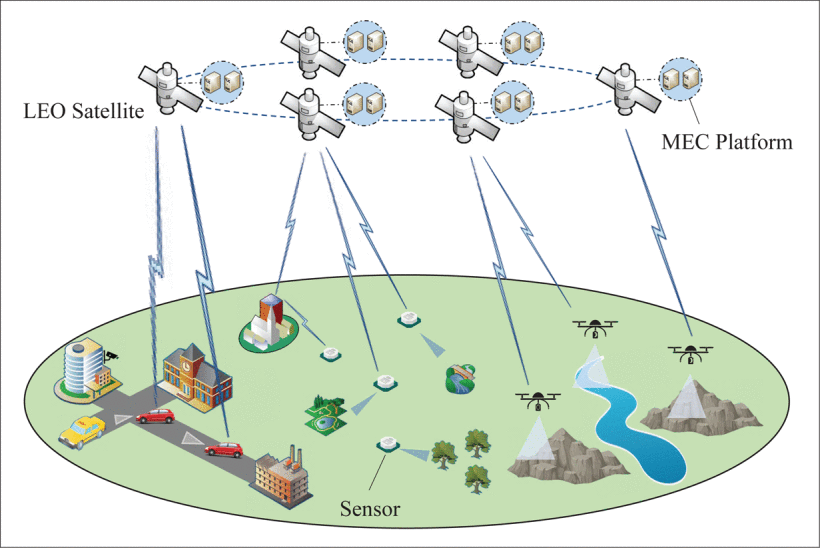
Fig. 1: Reference architecture of a satellite IoT system [1].
Potentials
Marine telematics, agriculture, oil and gas, mining, construction, and transportation industries face connectivity challenges in remote locations lacking traditional network infrastructure. Satellite IoT offers a reliable solution by enabling low-power telematics devices to function without constant connectivity, ensuring data tracking, monitoring, and emergency alerts. In marine and transportation, satellite IoT supports tracking across oceans and highways. In agriculture, it aids in data-driven decisions despite limited cellular coverage. For oil rigs, remote mining, and construction projects, satellite IoT overcomes infrastructure gaps, facilitating asset tracking, condition monitoring, and automated processes regardless of location.
Challenges
The design of satellite IoT systems differs significantly from terrestrial IoT systems. Unlike terrestrial APs, a single satellite covers a much larger area and serves a significantly greater number of devices. In dense LEO satellite constellations, overlapping coverage areas require precise scheduling to manage resources efficiently. This makes resource allocation and management in satellite IoT inherently more complex than in terrestrial systems. Furthermore, because satellites move continuously in orbit, they face rapidly changing communication environments, such as transitions between urban areas and oceans.
Conclusion
With advancements in satellite IoT technology, connectivity will soon extend to even the most remote areas of the planet, unlocking new opportunities across industries, enhancing environmental monitoring, and improving daily life. Satellite IoT paves the way for a truly connected world, where location is no longer a limitation.
References
[1] Y. Zuo, M. Yue, H. Yang, L. Wu and X. Yuan, “Integrating Communication, Sensing and Computing in Satellite Internet of Things: Challenges and Opportunities,” in IEEE Wireless Communications, vol. 31, no. 3, pp. 332-338, June 2024.
[2] M. Centenaro, C. E. Costa, F. Granelli, C. Sacchi and L. Vangelista, “A Survey on Technologies, Standards and Open Challenges in Satellite IoT,” in IEEE Communications Surveys & Tutorials, vol. 23, no. 3, pp. 1693-1720, third quarter 2021.

Dr. Samiru Gayan,
Senior Lecturer, Department of Electronic and Telecommunication Engineering,
University of Moratuwa.
